
The certified letter sits on the counter for three days before anyone opens it. I’ve watched that happen in kitchens from Brownsville to Beaumont, and the delay almost never comes from laziness. It’s dread.
But that envelope doesn’t tell you this: your name is still on the deed. Foreclosure strips your ownership only on sale day, not the day the paperwork lands. Until the gavel drops at the courthouse, you can sell, refinance, reinstate, or walk away on your own terms. I buy houses across the Rio Grande Valley, and a good share of them come from owners who thought the bank already owned the place. It didn’t.
What Does Foreclosure Mean for Texas Homeowners?
“Does the bank own my house now?” I get that question more than any other, usually in a low voice, usually with kids in the next room. No, it doesn’t. Foreclosure in Texas is a legal process your lender uses to force a sale of the collateral, and it ends with a public auction, not with an automatic transfer.
Most Texas mortgages are written as deeds of trust containing a power of sale clause. The lender’s trustee can sell the house at the county courthouse without filing a lawsuit at all, thanks to that clause. No judge. No hearing. For that reason, Texas moves faster than almost anywhere else in the country.
Your rights don’t disappear during foreclosure, though. You keep possession and the ability to sell, and any equity above what you owe still belongs to you, a point that gets ignored constantly. Lenders aren’t entitled to your windfall; they’re entitled to their balance plus costs.
Early last year I bought a house in Pharr from an heir living up in Oklahoma. The property was two payments from a posted sale, so selling it as-is let all three of them close out their mother’s estate without a single trip south.
No second chance exists in Texas after the hammer falls, which is the single most important thing to understand about foreclosure here. There’s no post-sale redemption period for a mortgage foreclosure; once the sale is complete, the property belongs to the new owner. Other states let you buy your house back months later. Texas doesn’t. Every strategy that works has to happen before the sale date.
What Types of Foreclosure Exist in Texas?
Maria assumed her late father’s lender would have to sue before taking the house, so she waited for a court notice that never came. By the time she figured out Texas allows non-judicial foreclosure, the auction was eleven days away.
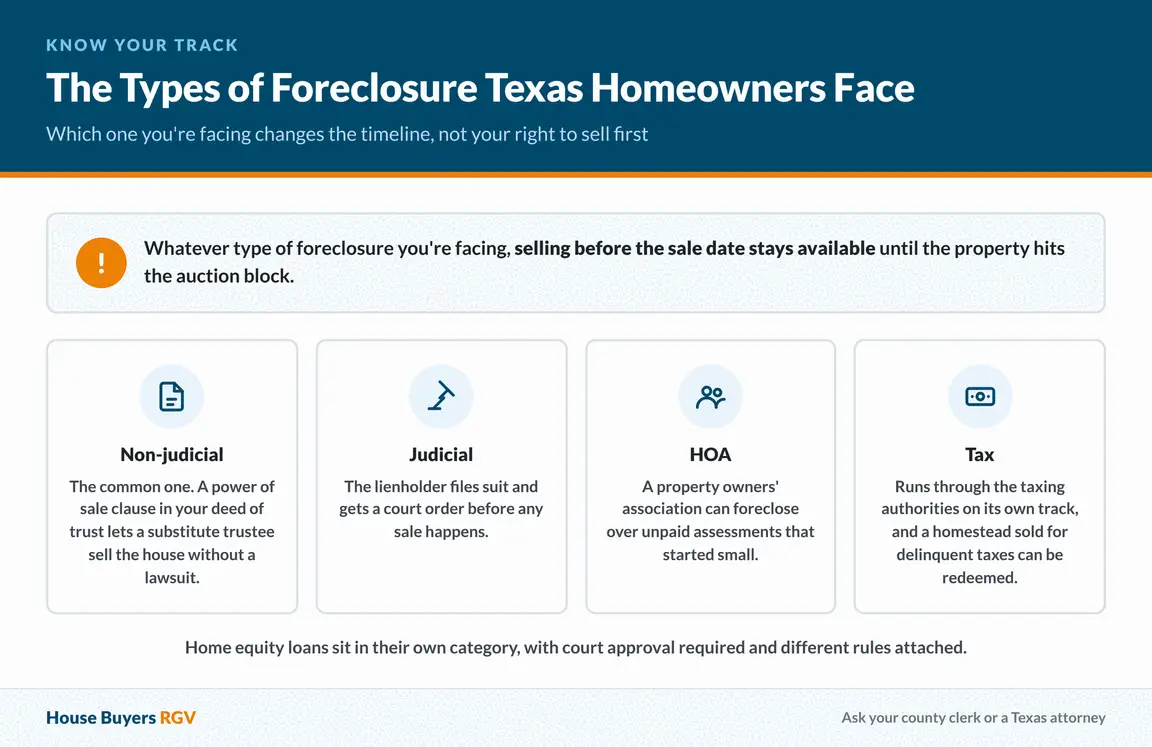
Non-judicial foreclosure is the common one in Texas, and it’s what the power of sale clause in your deed of trust authorizes. An ordinary deed-of-trust foreclosure usually proceeds without a lawsuit, though certain liens and disputes do require court involvement. Your lender hires a substitute trustee, the trustee sends notices, and the property goes to auction.
Judicial foreclosure means the lienholder files suit and gets a court order before any sale happens.
Then there’s the category Texas homeowners underestimate: HOA foreclosure. A property owners’ association can pursue foreclosure over unpaid assessments, and those balances start small. Home equity loans sit in their own category too, with court approval required and different rules attached.
Tax foreclosure runs on yet another track through the taxing authorities, carrying redemption rights that mortgage foreclosure doesn’t. A homestead sold for delinquent taxes can be redeemed; a homestead sold on a deed of trust cannot. Ask your county clerk’s office or a Texas attorney which track your situation falls under before you plan around a timeline.
Does the distinction change what you should do today? Just slightly. Regardless of which type of foreclosure you’re facing, selling before the sale date stays available to you, and that option closes the moment the property hits the auction block.
When Can a Lender Start Foreclosure in Texas?
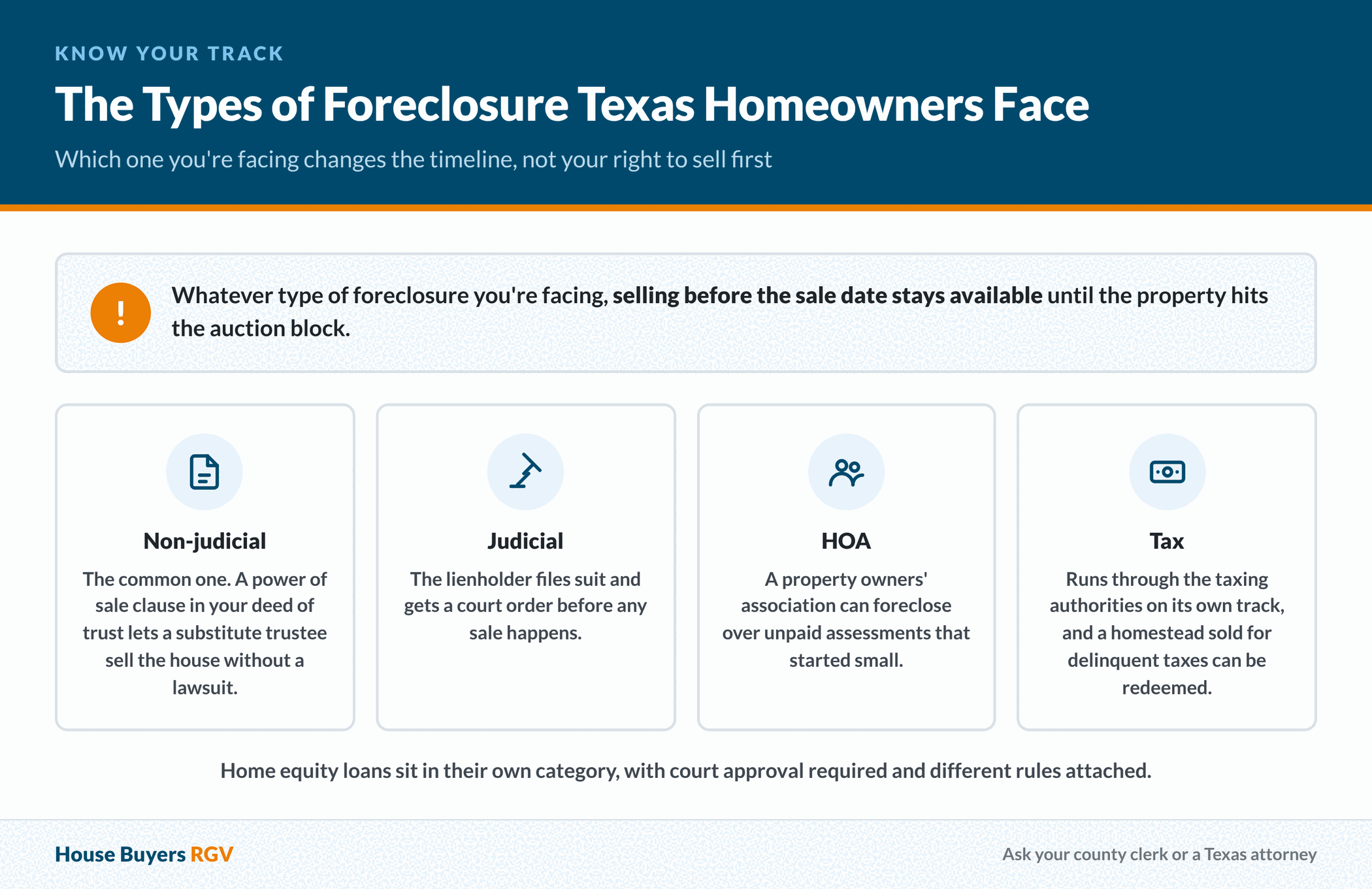
For years I assumed a Texas foreclosure could begin the month after a single missed payment, and I was wrong by about four months. Federal servicing rules changed that math. Most servicers can’t start foreclosure until you’re more than 120 days delinquent, which gives you roughly four months of runway before the formal notices even begin.
The most valuable asset you have is that window, and almost nobody uses it. Sellers tell me they stopped opening mail in month two, which means they burned a third of their runway on avoidance.
What happens after day 120 is where Texas foreclosure speeds up hard. Under Texas Property Code §51.002(d), your servicer is generally required to send written notice that you’re in default and give you at least 20 days to cure before accelerating the debt. Your reinstatement window, and certain loans stretch it to 30 days, including most FHA, VA, and home equity loans.
Several things can pause or restart this. For most servicers, a complete loss mitigation application received at least 37 days before a scheduled sale requires the lender to halt foreclosure activity.
Add the pieces together and you get a floor, not a ceiling. At least 20 days to cure plus at least 21 days of sale notice means a minimum of about 41 days from the cure notice to the foreclosure sale. Lenders often take longer in practice. Planning on longer is gambling with your house.
What Is the Foreclosure Process in Texas?
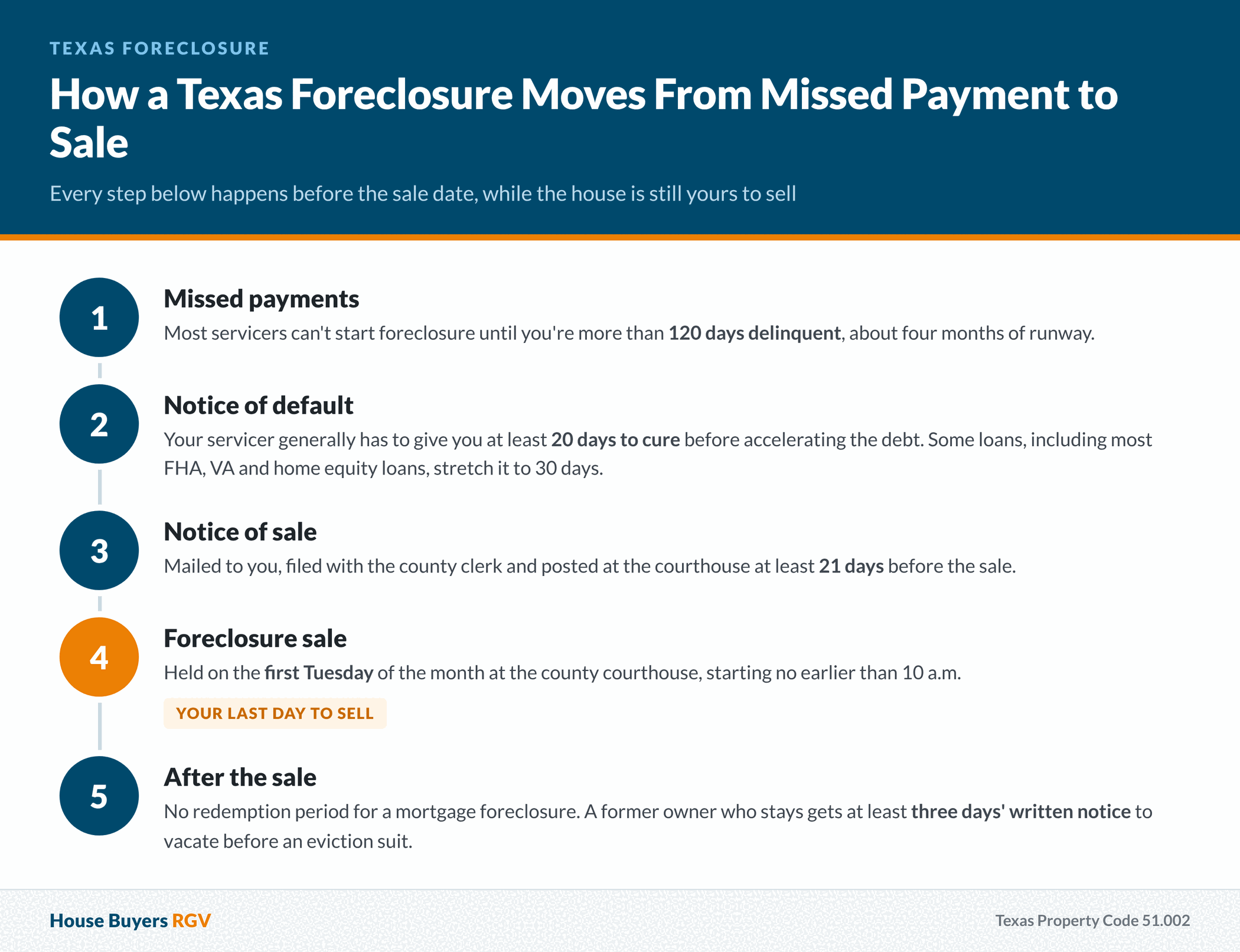
Homeowners picture foreclosure as a slow grind with judges, continuances, and months of procedural delay, but Texas runs it like a scheduled event on a calendar. Foreclosure sales happen on the first Tuesday of a month, every month, rain or shine, at the county courthouse.
The notice of sale is the document that matters most. It has to be mailed to you, filed with the county clerk, and posted at the courthouse at least 21 days before the sale date under Texas Property Code Section 51.002. All three steps are independent requirements. You can read the statutory language yourself at the Texas Property Code §51.002 text.
Counting those days trips people up. The 21 days run from the date the notice was mailed, not the date you received it, and refusing to collect certified mail won’t invalidate a Texas foreclosure sale.
On sale morning, the trustee reads the notice and takes bids, since Property Code 51.002(a) requires a public sale held between 10 a.m. and the time stated in the notice. Your lender submits a credit bid up to the amount owed.
One scheduling quirk worth knowing: when the first Tuesday lands on January 1 or July 4, Texas moves the foreclosure sale to the first Wednesday instead.
You should time this market more carefully than usual, since the numbers statewide show why. The Texas Real Estate Research Center’s August 2026 Housing Insight put the median sale price near $342,900, about 0.4% below year-ago levels, with roughly 5.4 months of active inventory. Inventory that deep means a conventional listing takes time you may not have before the foreclosure sale.
Can I Stay in My Home During Foreclosure in Texas?
And that courthouse auction doesn’t put you on the sidewalk that afternoon. You don’t have to move out on the sale date; if you’re still living in the home after foreclosure, the new owner has to evict you through the court process.
That process unfolds as follows. Most Texas deeds of trust contain a clause stating that the borrower becomes a “tenant at sufferance” after a foreclosure sale if they stay in possession. Property Code § 24.005(b) then mandates at least three days’ written notice to vacate before the new owner can file a forcible detainer suit, unless a written agreement sets a different period.
Any Texas article telling you otherwise is wrong, and acting on that wrong number costs families their belongings.
Renters get better treatment under Texas rules on this. When a property sells at a trustee’s or tax sale, the new owner must give an existing tenant in good standing written notice within a few weeks if they’re not continuing the lease. The federal Protecting Tenants at Foreclosure Act may entitle a bona fide tenant to finish the lease term or receive at least 90 days’ notice.
Delivery rules tightened recently. Under S.B. 38, effective September 1, 2025, notice can be delivered in person, by mail, or posted inside the property, and posting it outside is no longer permitted. TexasLawHelp publishes a plain-English foreclosure fact sheet that walks through the sequence.
An eviction on your record follows you into every rental application in Texas for years, and that consequence outlasts the foreclosure itself.
How Can I Stop Foreclosure in Texas Before It’s Too Late?
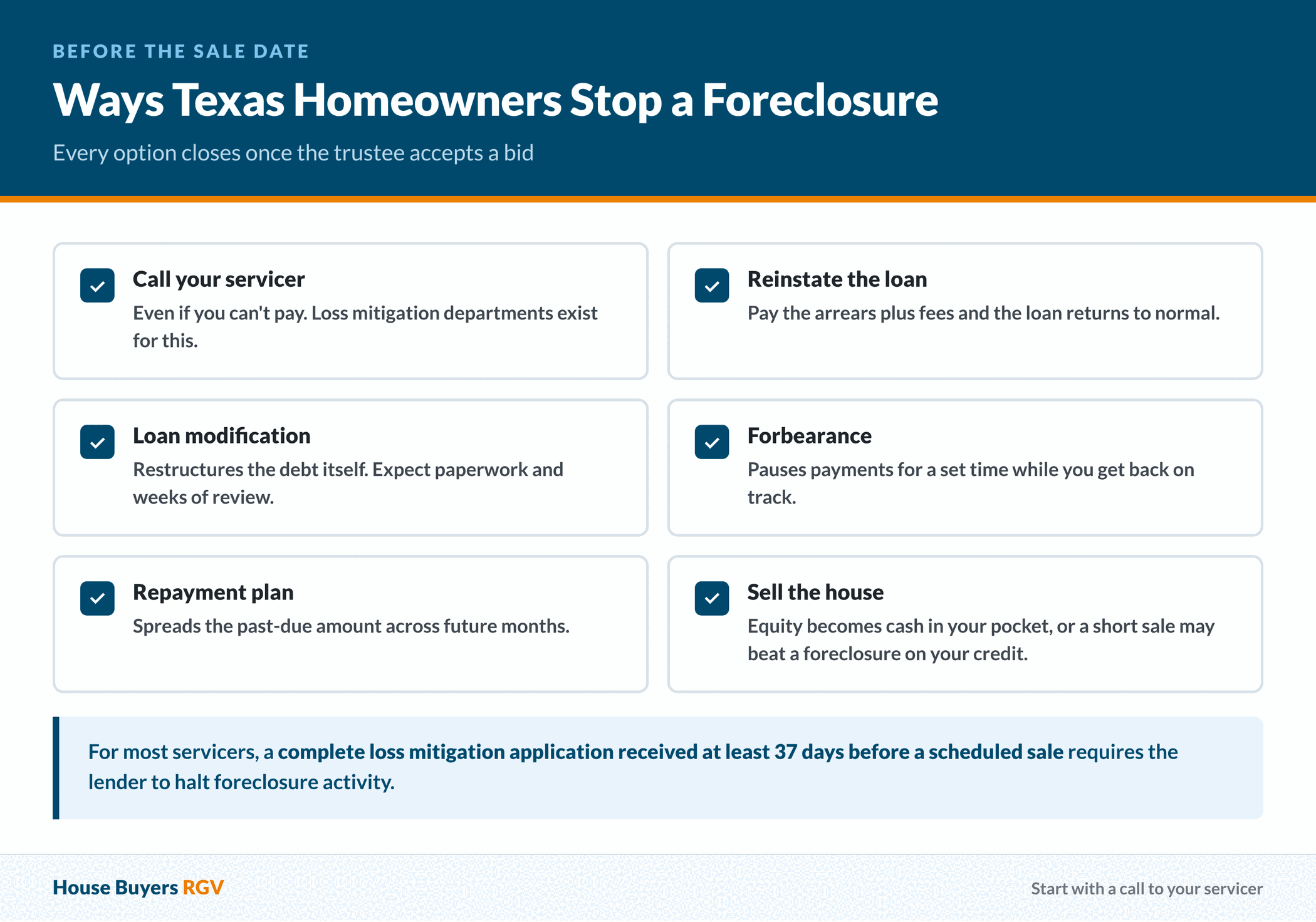
Pick up the phone and call your servicer today, even if you can’t pay a dime, because silence is the only move that guarantees you lose the house. Servicers have loss mitigation departments that exist for this.
Reinstatement is the cleanest exit from foreclosure if you can swing it. You pay the arrears plus fees and the loan returns to normal. Tax refunds, a family loan, a retirement withdrawal: I’ve seen all three pull a house back from a posted sale date.
Loan modification restructures the debt itself. Forbearance pauses payments temporarily. A repayment plan spreads the past-due amount across future months. Each one needs paperwork, and each one takes weeks the foreclosure calendar may not give you.
Sellers resist this option longest and regret skipping it most, but selling outright is often the smart move. If you’ve got equity, a sale converts it to cash in your pocket. If you don’t, a short sale negotiated with your lienholder may still beat a foreclosure on your credit report.
Can you realistically list a house and close before a posted sale date? Sometimes. Texas properties stayed listed a median of 63 days as of July 2026, and closing adds another month on top of that. Against a 21-day sale notice, conventional listing math doesn’t work. Against your 120-day federal runway, it works fine.
That gap is where direct buyers fill a real need in Texas. If you’re weighing that route, House Buyers RGV handles these situations across the Valley regularly.
Can Refinancing Stop a Texas Foreclosure?
Refinancing out of an active Texas foreclosure is possible on paper and rare in practice. Lenders underwrite on credit, and a borrower 120 days delinquent with a posted notice of sale doesn’t clear anyone’s guidelines.
The credit damage arrives before the foreclosure does. Four missed mortgage payments drop a score far enough that prime refinance programs close their doors automatically.
Equity is the one thing that changes the conversation. A homeowner with substantial equity in home value relative to the loan balance has options a maxed-out borrower doesn’t. Private lenders in Texas lend against the asset rather than the borrower when the cushion is wide enough.
Rates aren’t helping either. Mortgage rates were hovering around 7.4% in early October 2026. Refinancing a loan originated at 3% into a 7%-plus product to cure a default usually creates a payment you can’t sustain, which puts you back in foreclosure next year.
Texas home equity rules add their own layer. Cash-out refinancing on a homestead here carries constitutional restrictions that don’t apply in other states, including limits on how much equity you can tap. A Texas real estate attorney can tell you whether your property qualifies before you pay anyone an application fee.
Sellers asking about refinancing should get a straight answer from a lender in writing within a week, and if the answer is no, pivot immediately to selling or loss mitigation. Chasing a refinance that won’t close is how people burn their last thirty days before a foreclosure sale.
Does Bankruptcy Stop Foreclosure in Texas?
A seller in Corpus Christi filed Chapter 13 the Friday before a first-Tuesday sale, and the foreclosure came off the calendar. Eighteen months later the case was dismissed for missed plan payments, and the house went to auction anyway.
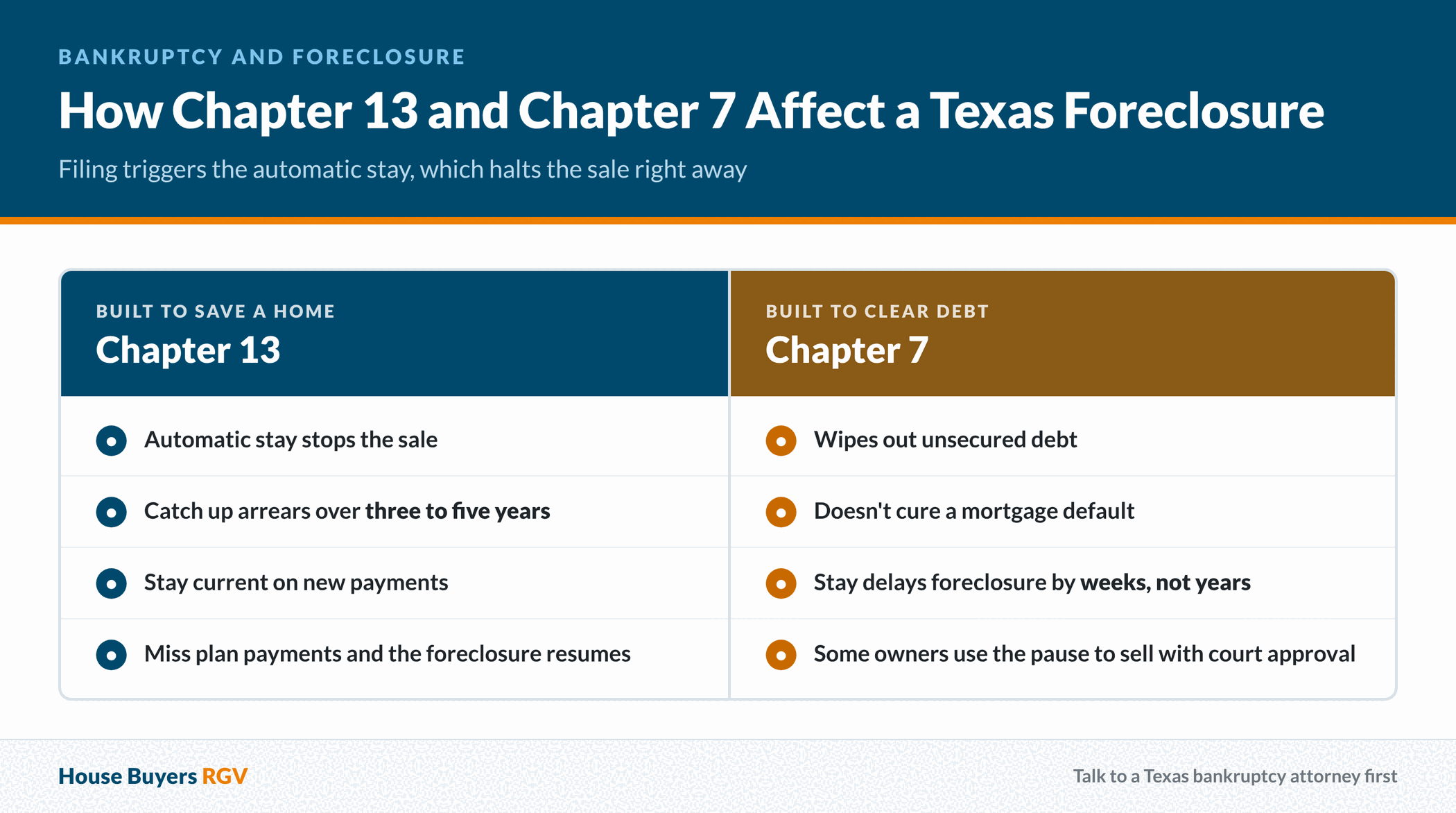
That’s the honest version of what bankruptcy does. Filing triggers the automatic stay, which halts a Texas foreclosure sale immediately.
Chapter 13 is the chapter built for saving a home. You propose a plan to catch up arrears over three to five years while staying current on new payments. Miss the plan payments and the lender files to lift the stay, and your foreclosure resumes right where it left off.
Unsecured debt gets wiped by Chapter 7, but it doesn’t cure a mortgage default. The stay delays foreclosure by weeks, not years. Some Texas homeowners use that pause to sell the property with court approval instead of losing it at auction.
Timing is unforgiving here. A filing on the morning of the sale can stop it, but trustees have been known to proceed when notice reaches them late. Attorneys want the petition filed well before the first Tuesday for exactly that reason.
Bankruptcy has one underrated benefit after a Texas foreclosure: it can discharge a deficiency the lender pursues afterward.
Legal advice is not something I’m licensed to give, and bankruptcy is genuinely complicated, so talk to a Texas bankruptcy attorney before filing anything. Many offer free consultations, and the wrong chapter filed at the wrong moment wastes your best remaining leverage.
Can I Sell My House During Foreclosure in Texas?
Is it too late once the sale date is posted? A widow in McAllen called me with nineteen days left before her foreclosure sale. Her late husband had handled every payment for forty-one years, and she’d never seen a mortgage statement in her life.
Yes, you can sell a house in foreclosure in Texas, right up until the trustee accepts a bid at the courthouse. Your name stays on the deed until that moment.
Mechanically, the sale works like any other closing with one addition: the title company orders a payoff statement from the servicer and wires the full amount at funding. The lien releases, the foreclosure gets rescinded, and whatever’s left over goes to you.
Equity decides which path makes sense. With real equity, a traditional listing may net you more if you’ve still got months of runway. With thin or negative equity, you’re looking at a short sale, where the lienholder agrees to accept less than the balance. Short sales take lender approval and that approval takes weeks, so starting early is everything.
Sellers need price realism in this Texas market more than three years ago. Median seller price cuts statewide ran around $12,000, roughly 3.3% off the initial asking price, in the August 2026 TRERC data. Overprice a house you’re trying to sell against a foreclosure deadline and you’ll be cutting price in week five with no time left.
A man called on a Wednesday afternoon from Weslaco about his father’s house. We bought it as-is, left him the tools, and he never had to clear a single room.
Direct buyers aren’t right for everyone, and anyone telling you otherwise is selling something. But when a Texas foreclosure sale date is posted and you need certainty over top dollar, a cash close is the only tool that reliably beats the calendar.
Can a Lender Sue Me for a Deficiency After Foreclosure in Texas?
“The house is gone, so the debt is gone too, right?” Not necessarily, and this is the part of Texas foreclosure that reaches people long after they’ve moved out.
Under Texas Property Code § 51.003, when a foreclosure sale brings less than the unpaid balance, the lender has to file any deficiency action within two years of the sale.
Texas gives you a meaningful defense, though. If the court finds the property’s fair market value exceeded the foreclosure sale price, you’re entitled to an offset for the difference. Evidence can include expert testimony, comparable sales, anticipated marketing time and holding costs, and cost of sale. The statutory text of § 51.003 spells out the procedure.
One category of loan is off-limits entirely. Texas law doesn’t allow a deficiency judgment after foreclosure of a home equity loan, under Article XVI, § 50(a)(6)(C) of the Texas Constitution. Non-recourse by design.
Selling before the foreclosure sale sidesteps this whole risk. A negotiated short sale can include written release of the deficiency, and a full-payoff sale leaves nothing to pursue. That protection is worth real money, and it never shows up in the price comparison sellers run in their heads.
Frequently Asked Questions
Can I Get My Property Out of Foreclosure in Texas?
You can, as long as you act before the trustee’s sale. Reinstating the loan by paying the past-due amount plus fees restores everything to normal, and a loan modification or forbearance agreement through your servicer’s loss mitigation department can accomplish the same thing on different terms. Selling the property and paying the lien off in full also removes the foreclosure. Once the property sells at auction, none of these work, because Texas offers no redemption after a mortgage foreclosure sale.
How Long Does Foreclosure Last in Texas?
Count from your first missed payment and you’re usually looking at somewhere around six months, though it can stretch longer depending on your servicer’s pace. Federal rules give you several months of delinquency before anything formal starts, and the statutory notice periods described earlier add roughly six more weeks on top of that. Texas runs one of the fastest foreclosure timelines in the country, so treat every week as if it counts.
How Much Notice Do I Get to Vacate My Home After a Foreclosure in Texas?
As the former owner, you’ll get a short written notice to vacate, as described in the section above, before the new owner can file an eviction suit in justice court. That notice is far briefer than most people expect. If you were renting the property rather than owning it, both Texas law and federal tenant protections give you considerably more time, and the lease itself may give you more still.
How Long After a Foreclosure Sale Do I Have to Move in Texas?
Practically speaking, you’ve got the notice period plus however long the court process takes, since the new owner can’t physically remove you without a judgment and a writ of possession from the justice of the peace. That usually adds a few weeks beyond the written notice. Many purchasers will offer relocation money to avoid filing at all, so it’s worth asking rather than waiting silently for a constable.
If you’re staring at a notice and trying to figure out what your Texas house is really worth against what you owe, we’re glad to walk through the numbers with you. No pressure, no obligation, and no judgment about how you got here. Reach out to House Buyers RGV whenever you’re ready, or just call to think out loud with somebody who’s seen this before.
Facing Foreclosure in Brownsville and the Rio Grande Valley
The local market matters as much as your sale date. Brownsville averaged about 1,859 active listings a month in the first half of 2026, down 7 percent from a year earlier, according to Redfin’s mid-year Brownsville review.
That’s still plenty of competition for a house with a posted sale date. If you’d rather skip the listing, House Buyers RGV buys houses in Brownsville and the towns around it as-is, so you can close before the first Tuesday arrives.
Talk Through Your Foreclosure Options With Us
You don’t have to decide anything on the first call. Tell us your sale date, what you owe and what shape the house is in. We’ll give you a fair cash offer and show you what each path could leave in your pocket. If a loan workout or a listing fits you better, we’ll say so. Reach out to our team or fill out the form below to get started.