
A sister calls her brother and says she’ll “just sign the house over.” Both of them picture a quick form, a notary at the credit union, and a problem solved before dinner. It often goes exactly that way. Other times that single page creates a title cloud that sits on the property for years, surfacing the day somebody tries to sell. A quit claim deed in Texas is a legitimate tool, and I’ve watched it work cleanly dozens of times. I’ve also watched it blow up a closing. Almost always, the difference is whether the people signing understood what they were signing.
What Is a Quit Claim Deed in Texas?
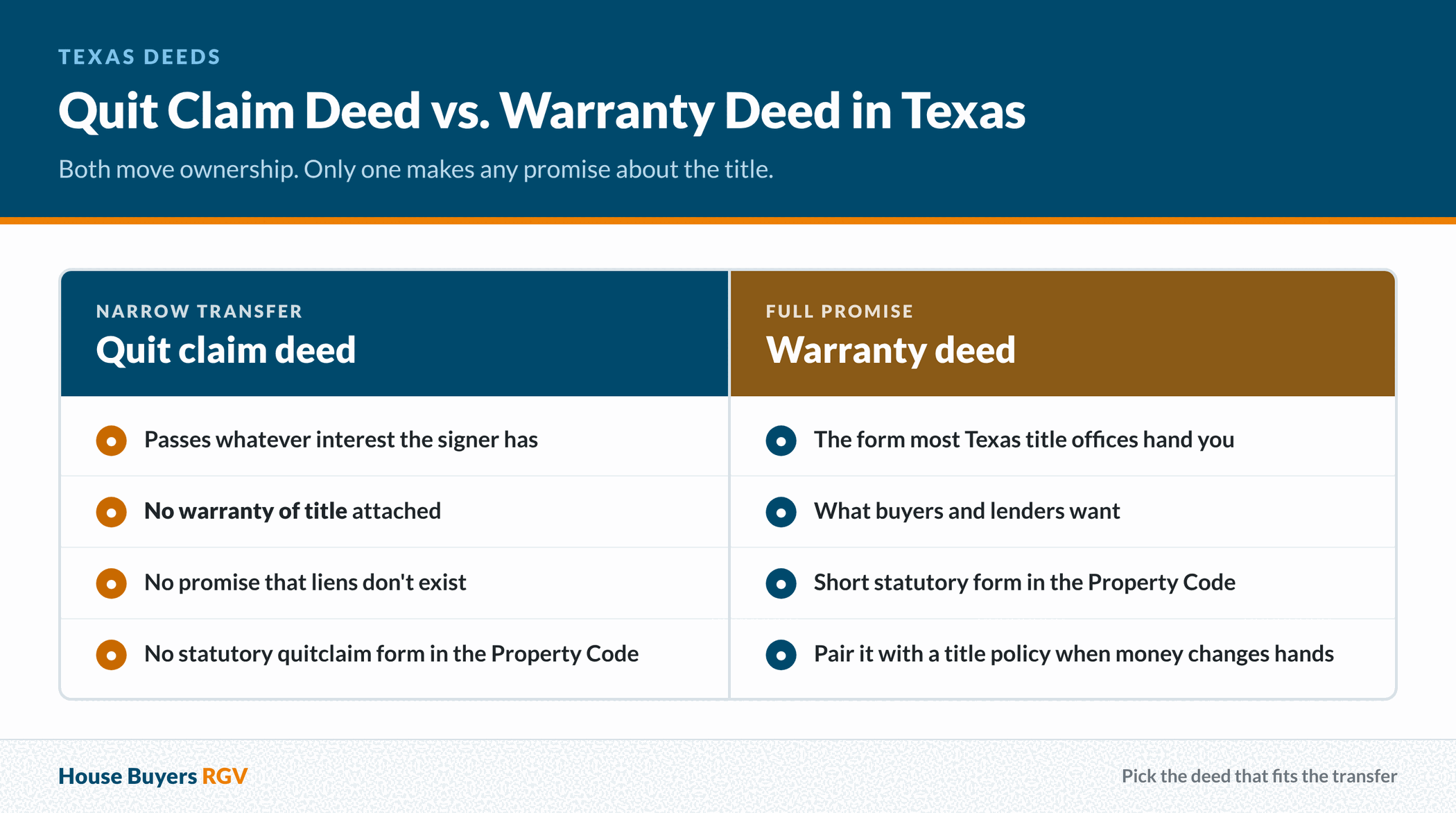
Walk into most title offices in Texas and ask for the form that “transfers the house,” and you’ll get a warranty deed. Buyers and lenders want that instrument. A quit claim deed does something narrower and far less comforting.
What this document hands over is whatever ownership interest the signer happens to have at that moment. Nothing more. It passes along that interest without any warranty of title attached, so if the person signing owns a clean one hundred percent, the recipient gets a clean one hundred percent. If that person owns a disputed quarter interest inherited from a grandfather, the recipient gets exactly that mess.
No promise comes with it. The grantor isn’t swearing the title is good, isn’t swearing there are no liens, and isn’t agreeing to fix anything later.
There’s also no official template handed down by the state. No statutory quitclaim form exists, and the short statutory form in the Property Code covers warranty deeds only. The document you file is whatever you or your attorney drafted, which is one reason sloppy ones circulate so freely.
Not long ago I sat with two adult children in Mission whose mother had just moved into assisted living out by Shary Road. They’d already signed one between themselves, thinking it settled ownership of the house, and the garage was still stacked with her sewing machines and canning jars from the seventies. The deed moved their interests around just fine, but it didn’t touch the reverse mortgage sitting on the property, and this is the gap I keep running into across Texas.
What Does Texas Law Say About Quit Claim Deeds?

The way Texas courts treat the instrument explains that gap. Quitclaim deeds are legal in Texas. Legal, though, isn’t the same as protective.
For any deed to work in Texas, a short list of elements has to be present: a grantor competent to convey, a grantee identified clearly, a usable property description, the grantor’s signature, and delivery. This type of deed in Texas has to clear that same bar, and the signature also needs to be acknowledged before a notary before the county clerk will record it.
Texas runs a notice recording statute, which is where things get interesting. Section 13.001 of the Property Code says an unrecorded conveyance is void as to a creditor or a later purchaser who pays value without notice of it. You can read the exact text at the Texas Real Estate Research Center’s explainer, which walks through it with examples.
One wrinkle sets quitclaims in Texas apart from every other conveyance. A recorded quit claim in the chain of title has historically served as a red flag to anyone reviewing it, and once I’ve seen that flag on a title search it’s hard to unsee. Because the quitclaim counts as legal notice of a possible competing claim, a buyer in that chain cannot qualify as a bona fide purchaser. In a title dispute, that protection matters enormously.
Texas did soften this, so there’s at least some relief built in. Once a quitclaim has been on record for four years, it no longer automatically operates as notice of someone else’s potential claim. That rule covers quitclaims recorded on or after September 1, 2021. A buyer in that chain can qualify as a bona fide purchaser. Four years is a long time to wait if you need to sell next spring.
When Should You Use a Quit Claim Deed in Texas?
A divorcing couple in Edinburg needed one spouse’s name off the house before refinancing, and the decree already spelled out who kept the property. One page, one notary stamp, done in an afternoon.
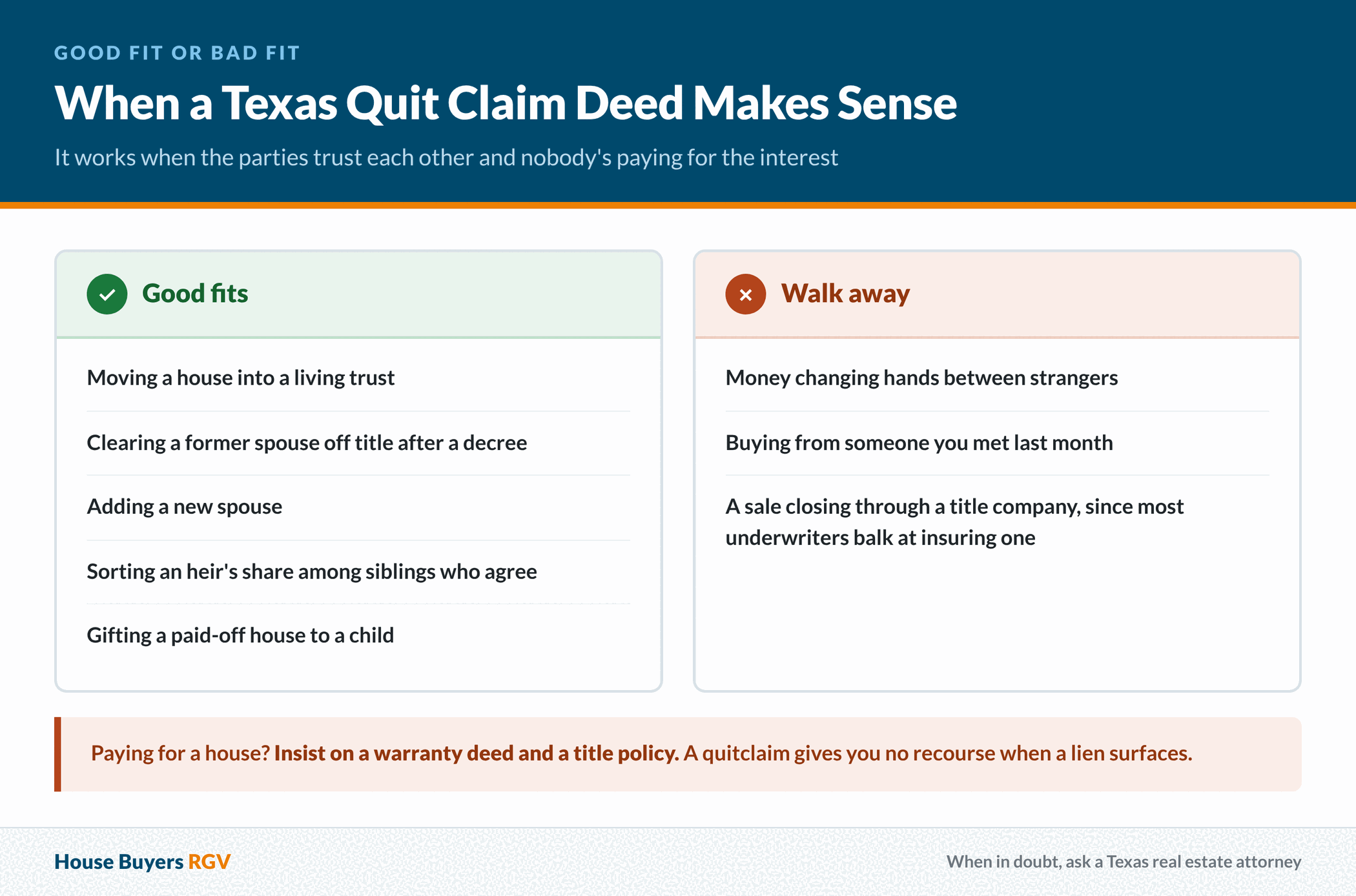
That’s the sweet spot. A quit claim deed in Texas earns its keep when the parties already trust each other and nobody’s paying money for the interest being moved.
Common fits include moving a house into a living trust, clearing a former spouse off title after a decree, or adding a new spouse. Another fit is straightening out an heir’s fractional share among siblings who all agree on the split. Sometimes a misspelled name on a prior deed gets corrected this way too, though a correction instrument is often the better fix.
So when should you walk away? Any transaction with money changing hands between strangers. If you’re buying a house in Texas from someone you met last month, this type of deed gives you no recourse whatsoever when a lien surfaces. Insist on a warranty deed and a title policy.
Gifts between family members are the other clean use. Parents in Texas pass a paid-off house to a child this way all the time, and when the title is already clear and everyone’s on speaking terms, it works.
My blunt opinion: if a title company is involved in your transaction, you won’t be using one in Texas anyway. This is because most underwriters in Texas balk at insuring a title that rests on one. The instrument’s actual strength is revealed by that reaction.
What Risks Come with a Texas Quit Claim Deed?
“But my cousin did one and nothing bad happened.” Fair. Plenty of quit claim deeds in Texas sit in county records for decades without causing a ripple, because the title underneath them was clean to begin with. The deed didn’t make it clean. It just didn’t make it worse.
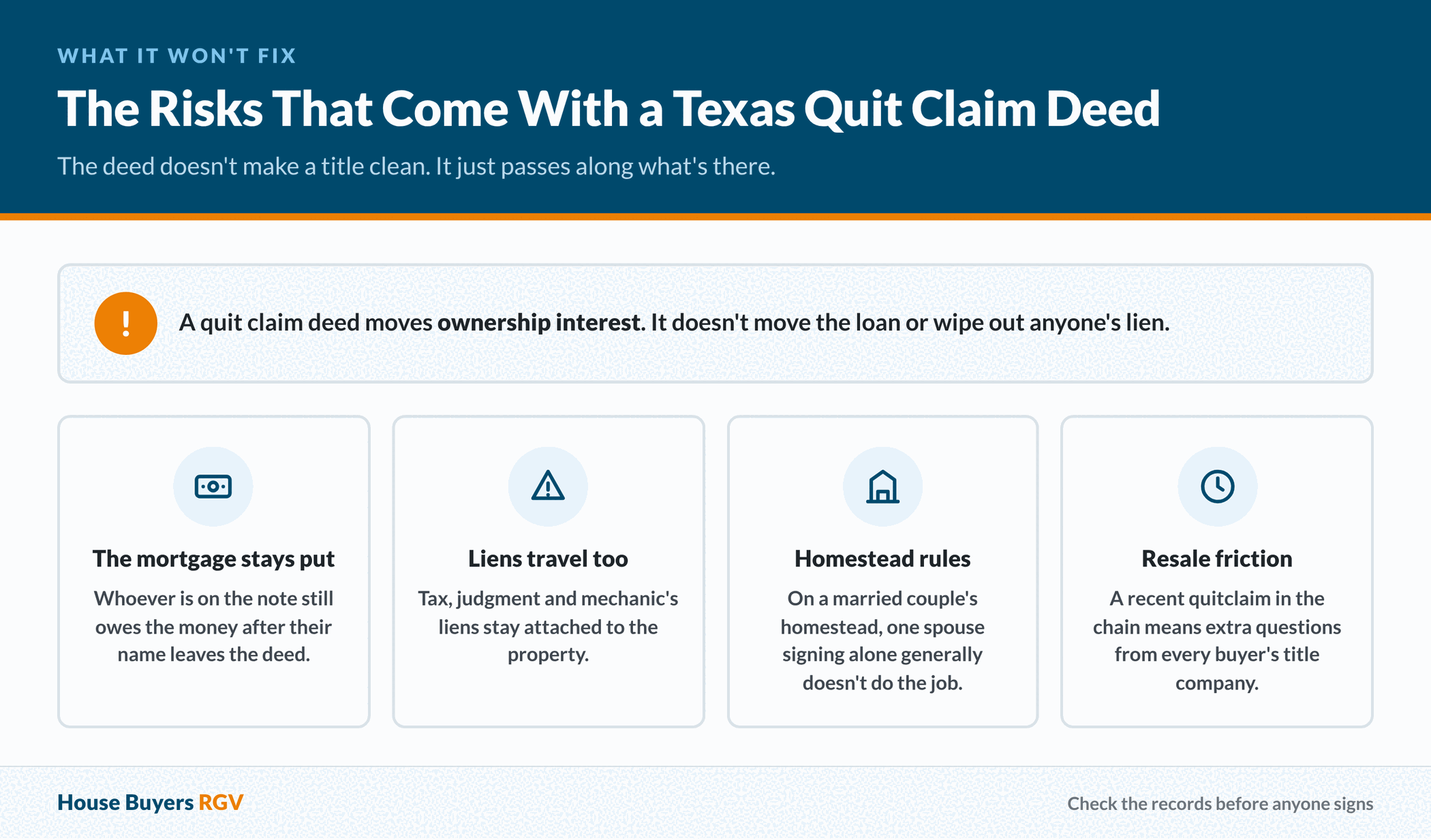
Risk number one: the mortgage stays put. Signing one in Texas moves ownership interest, but it doesn’t move the loan. The person whose name is on the note still owes the money even after their name leaves the deed, and that mismatch has wrecked more credit scores than I can count.
Liens travel too. A quitclaim conveys only the grantor’s interest and doesn’t strip away anyone else’s liens or encumbrances. Tax liens, judgment liens, mechanic’s liens from that roofer in 2019: all still attached.
Then there’s the homestead problem. If the property in Texas is a married couple’s homestead, one spouse signing alone generally doesn’t do the job. Homestead protections in Texas run deep, and the county clerk won’t catch the error for you.
Have you checked whether anyone else might have a recorded claim on your property? A lot of people haven’t looked since the day they bought it.
Nobody weighs the risk of resale friction properly. Marketing a house in Texas with one in the recent chain means answering questions from every buyer’s title company. That takes weeks you may not have.
How Does a Quit Claim Deed Work on a Texas House?
Before: three siblings in San Benito each held an undivided interest in their late father’s house, and two of them wanted out. After: one signed deed each, recorded the same week, and the remaining sibling held the whole thing.
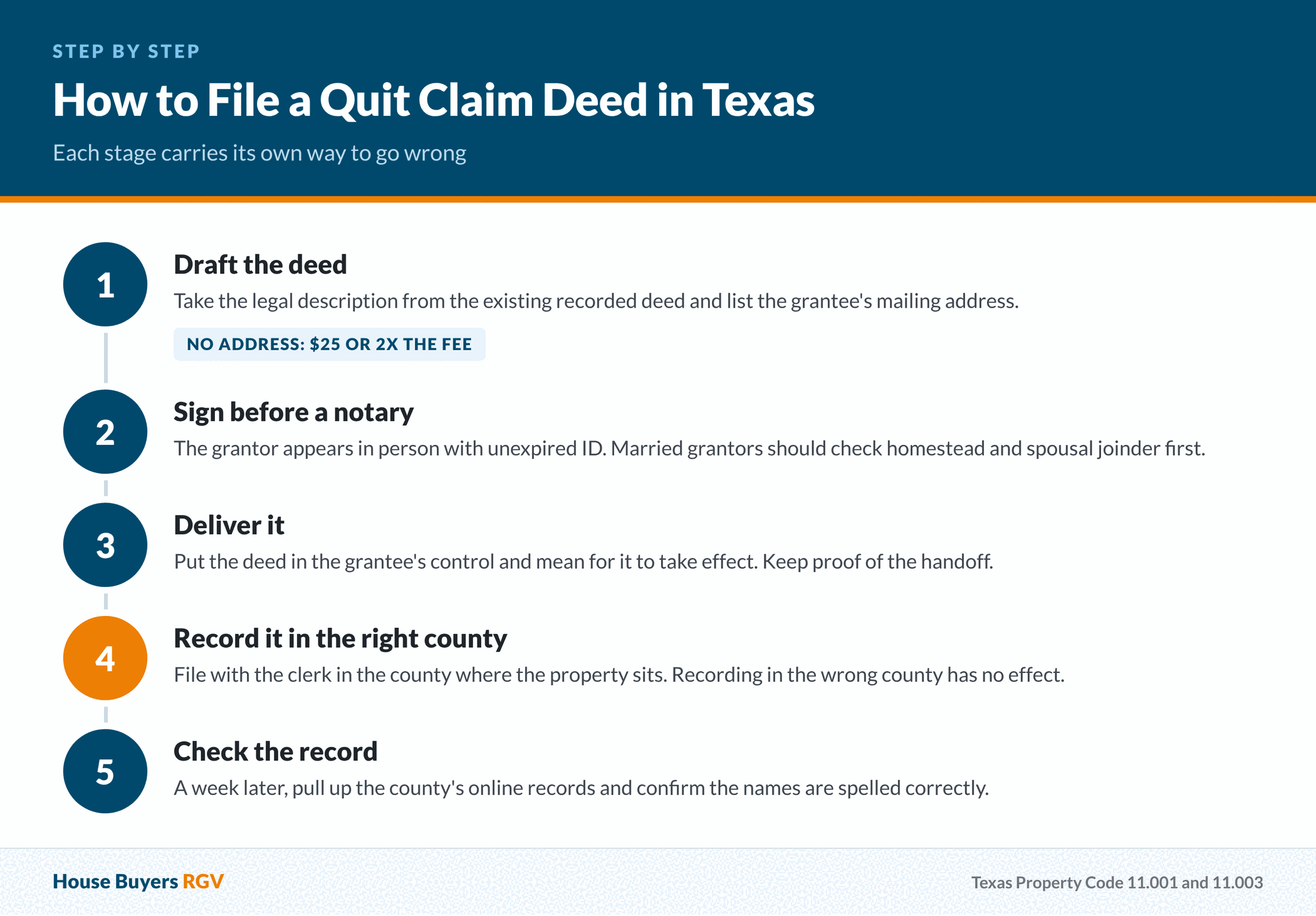
Mechanically, this type of deed in Texas moves through five stages, starting with drafting, which is where most DIY attempts go sideways. The legal description has to come off the existing recorded deed, not off a tax statement. Tax records in Texas use abbreviated descriptions that a clerk may accept and a title examiner will later reject.
People expect grantee information to matter less than it does. The grantee’s mailing address has to appear on the deed under Section 11.003, and without it the county clerk may refuse to record. Leave it off and you can trigger a penalty of the greater of $25 or twice the recording fee.
Signing comes next, then delivery, then recording. Each stage carries its own failure mode.
What a quit claim deed in Texas won’t do, at any stage, is create ownership out of thin air. Sign one on a house you don’t own in Texas and you’ve transferred precisely nothing, though you’ve also muddied the county records for everyone who comes after.
Timing deserves a thought too. The statewide median sale price in Texas slipped 0.4 percent year over year to $333,628 in the third quarter of 2026, according to Texas REALTORS®, with the typical home selling in 99 days. A title defect discovered mid-listing can easily double that clock.
What Happens at Signing a Quit Claim Deed in Texas?
For years I told people the notary was a formality. Wrong, and I’ve since corrected myself with every seller who asks.
The notarization isn’t decoration. Acknowledgment is a condition of recording rather than validity between grantor and grantee, but without it the county clerk won’t record the deed at all. An unrecorded deed in Texas leaves you exposed to exactly the statute described earlier.
Only the grantor signs. The person receiving the interest usually doesn’t need to sign it in Texas, though their name and address must appear on the document. That surprises people who expect a two-signature closing.
Bring real identification. A notary in Texas will reject an expired license, and the grantor needs to appear in person. Mobile notaries cover hospitals and nursing homes across Texas, which matters when the grantor can’t travel.
Married grantors should think carefully before anyone picks up a pen, because homestead rights, community property questions, and spousal joinder all intersect here. One signature short and you’ve created a problem that costs real money to unwind.
Many deeds in Texas open with a notice of confidentiality rights, letting individuals strike their Social Security and driver’s license numbers before filing. That notice belongs at the top of the form.
Read the document out loud before signing. Sounds silly. It catches transposed lot numbers better than any other trick I know.
How Does Delivery Affect a Quit Claim Deed in Texas?
Delivery is a legal requirement separate from signing and separate from recording, and it has two parts. The grantor must put the deed within the grantee’s control, and must intend the document to operate as a conveyance. Intent carries as much weight as the physical handoff.
Signing a quit claim deed and locking it in a desk drawer accomplishes nothing if you never intended it to take effect yet. Courts in Texas look at behavior, not just paper.
Recording isn’t what makes the transfer real between the two parties. An unrecorded deed still binds the parties to the conveyance; recording isn’t necessary to pass title. Plenty of folks in Texas find a signed deed in a parent’s files and assume it’s worthless because it was never filed. It may not be.
Against the rest of the world, though, recording is everything. Texas treats recording as notice to the world and as the thing that establishes priority if a seller tries to convey the same property twice. You can review the mechanics at LoneStarLandLaw’s recording overview.
Delivery also can’t happen after death. A quit claim deed in Texas found among a deceased person’s papers, never delivered, generally passes nothing, and the property goes through probate instead. Families lose months to this.
Date the delivery. Keep an email, a text, a photo of the handoff. When a quitclaim in Texas gets challenged years later, proof of when control changed hands is what settles the argument.
How Do You File a Quit Claim Deed with the County Clerk?
Drive the deed to the courthouse yourself. Don’t mail it if you can help it, and don’t hand it to someone who’s “going that way anyway.”
Under Texas Property Code section 11.001, the deed gets recorded in the county where part of the property sits, and recording in the wrong county has no effect. Owners who live in Houston and own rental property in Harlingen trip over this constantly.
Texas has 254 counties, and the Secretary of State publishes a list of every county clerk with address and phone number. Whoever hands a deed across the counter in Texas has to show photo identification.
Fees run by the page and get set locally. Recording fees vary by county and are generally based on page count. Call the clerk in the county where your property sits and ask for the current first-page and additional-page charges before you drive over. Texas charges no transfer tax on the conveyance itself.
Some offices have moved online. A number of Texas counties now offer electronic recording through approved vendors, so check the county clerk’s website for availability and procedure.
What comes back to you is the original, stamped with a volume and page or a clerk’s file number. Store it with your closing papers. Pull up the county’s online records a week later and confirm the index shows your names spelled correctly.
Will the clerk tell you whether your deed accomplishes what you wanted? No. Recording runs through the county clerk’s office where the property sits, and Texas keeps no centralized state deed registry. Clerks check formatting, not legal effect.
What Does a Real Quit Claim Deed Example Look Like?
In Brownsville, the median sold price hit $249,000 as of October 2026 across 446 tracked closings. Picture a house at that number, inherited by four cousins, three of whom live in San Antonio and want nothing to do with it.
Each of the three signs a separate quitclaim, conveying an undivided one-fourth interest to the fourth cousin. The document names the grantor, names the grantee with a mailing address, and recites the legal description from the 1998 warranty deed. It states the consideration as ten dollars and other good and valuable consideration, and includes the operative words “quitclaim” rather than “grant, sell and convey.”
Below that sits the notary acknowledgment block. Three deeds, three trips to a notary, three recordings in Cameron County.
What that stack does and doesn’t do: the remaining cousin now holds all four interests on paper. The 2004 home equity loan one cousin took out against her share? Still there, still attached.
A landlord in Harlingen called me after quietly covering two mortgages for close to a year. These were the inherited duplex on one side and his own place on the other. A tenant had stopped paying in the spring. He’d signed a quit claim deed from his brother on a Saturday at a shipping store notary and never recorded it. He found out the hard way that a title company wanted considerably more than that one page. This is a mistake I’ve seen trip up more than one seller who thought the paperwork was done. If you’re carrying two payments while a title question sits unresolved, we’ve helped homeowners in that spot at House Buyers RGV, and sometimes the answer is just getting the right deed recorded.
Frequently Asked Questions
Get the deed wrong and you don’t find out at the courthouse. You find out at a closing table, with a buyer waiting and a title commitment full of exceptions.
How Much Does It Cost to File a Quit Claim Deed in Texas?
Your only unavoidable cost is the county clerk’s recording fee, which is charged per page and set by the county where the property sits. Call that clerk’s office and ask for the current rate before you go, since it differs from one Texas county to the next. Add a notary fee, and add attorney fees if you have one draft the document. There’s no state transfer tax on the conveyance itself in Texas.
Can I Prepare and File a Quit Claim Deed Myself?
You can. Nothing in Texas law requires an attorney to draft one, and people file them without help every day. I’d still push back on doing it alone when a mortgage, a homestead, a divorce decree, or more than two parties are involved. A lawyer’s fee is small next to the cost of clearing a bad deed later. If the property is paid off and you’re simply moving it between family members who agree, a well-drafted form and a careful read of the legal description usually gets it done.
Do You Receive a Deed Once Your Texas Mortgage Is Paid Off?
No new deed shows up. You already hold the deed from when you bought the house; what your lender files in Texas is a release of lien, which removes the deed of trust from the record. Watch for that release to appear in the county records within a few weeks of your final payment, and follow up with the servicer if it doesn’t. A missing release can hold up your next sale just as surely as a title cloud.
What Are the Real Disadvantages of a Quit Claim Deed in Texas?
The big one is that you get no warranty at all, so if the title turns out to be defective, you have nobody to go back to. Title companies in Texas tend to treat one in the recent chain as a reason for extra scrutiny, which slows a sale down. The deed also leaves any mortgage and any existing liens exactly where they were, and recording in the wrong county does nothing for you at all. For a paid-off family transfer among people who trust each other, those drawbacks may not matter much.
Does a Quit Claim Deed in Texas Remove My Name From the Mortgage?
It doesn’t. Those are two separate things, and conflating them is the most expensive mistake I see. Removing your name from the loan takes a refinance by the remaining owner, or a formal release from the lender, neither of which the county clerk has anything to do with. Sort the financing out first, then handle the deed.
If you’re sitting on a Texas house with a title question, an inherited share you don’t want, or payments you can’t keep carrying, we’re glad to talk it through. We’ll tell you honestly whether a quitclaim even helps. Reach out to us at House Buyers RGV whenever you’re ready. No pressure, no obligation, and no hard feelings if the answer is that you should call a real estate attorney instead.
Quit Claim Deeds and Inherited Houses in Brownsville
A lot of the deeds we see in Cameron County come from families splitting an inherited house. Homes in Brownsville took a median of about 81 days to sell in the first half of 2026, per Redfin’s mid-year Brownsville review. A title question can stretch that wait even further.
If your family would rather sell than sort out shares, House Buyers RGV buys houses in Brownsville and across the Valley. We work with the title company to clear the paperwork before closing.
Get a Straight Answer on Your Title Question
Tell us who’s on the deed, what’s owed and what you want to happen to the house. We’ll tell you honestly whether a quitclaim solves it or whether you need an attorney first. If selling makes sense, we’ll make you a fair cash offer with no repairs needed. Contact our team or use the form below whenever you’re ready.